


The health of any democracy depends on informed and engaged citizens of all ages. However, for more than a decade, young Canadians have voted much less than older age groups.
This page explores voter turnout trends, why youth are less likely to vote and the actions being taken to support youth participation in elections.
Trends in official voter turnout
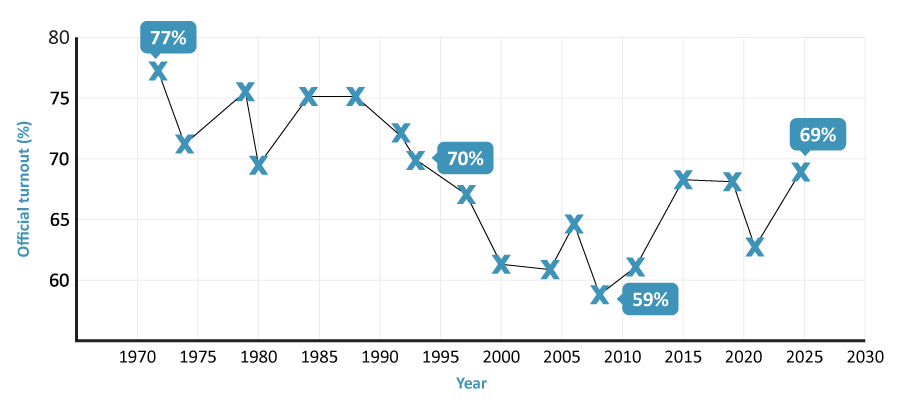
Before the 1990s, official voter turnout1 was 70% or higher in most federal elections. Voting rates declined in the following years, hitting a record low of 59% in 2008.
Text version of figure 1
| Election year | Voter turnout |
|---|---|
| 1972 | 77% |
| 1974 | 71% |
| 1979 | 76% |
| 1980 | 69% |
| 1984 | 75% |
| 1988 | 75% |
| 1993 | 70% |
| 1997 | 67% |
| 2000 | 61% |
| 2004 | 61% |
| 2006 | 65% |
| 2008 | 59% |
| 2011 | 61% |
| 2015 | 68% |
| 2019 | 67% |
| 2021 | 63% |
| 2025 | 69% |
This downward trend reversed in 2011 and voting rates for the 2015 election were even more positive (68%) before dropping again.
In the 2025 federal election, turnout increased to 69%, which is 6.4 percentage points higher than in 2021 (63%) and the highest rate since 1993.
This signals a positive change in overall voter participation. But are these trends the same across age groups2?
Voting trends by age
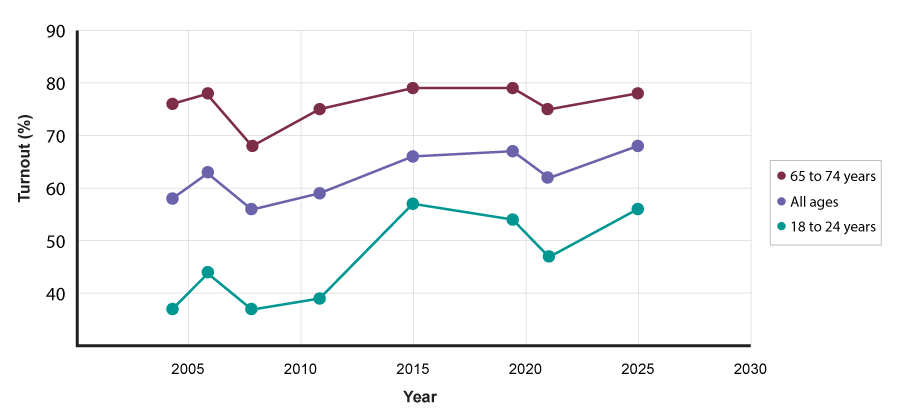
In 2025, voter turnout:
- was lowest for ages 18–24 at 56%
- increased with age, peaking at 78% for ages 65–74
- then dipped to 69% for ages 75 and over
Using Elections Canada’s Voter Turnout Visualization tool, you can see this same pattern in every general election since 2004.
Text version of figure 2
| Federal election year | Voter turnout (ages 18–24) | Voter turnout (ages 65–74) | Voter turnout (all ages) |
|---|---|---|---|
| 2004 | 37% | 76% | 58% |
| 2006 | 44% | 78% | 63% |
| 2008 | 37% | 68% | 56% |
| 2011 | 39% | 75% | 59% |
| 2015 | 57% | 79% | 66% |
| 2019 | 54% | 79% | 67% |
| 2021 | 47% | 75% | 62% |
| 2025 | 56% | 78% | 68% |
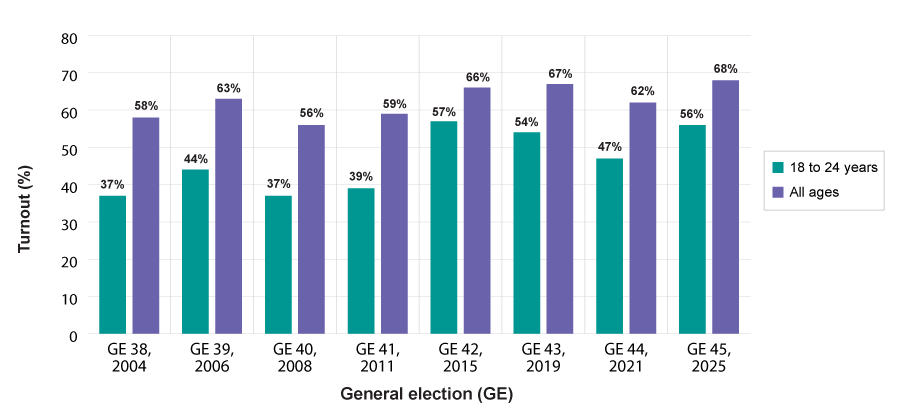
Youth participation in 2025 increased by 9.2 percentage points compared to 2021 but didn’t surpass the peak turnout rate of 2015 (57%). Still, this shows improvement compared to the 2004–2011 period, when the turnout gap between youth (18–24) and older adults (65–74) reached as much as 36 percentage points.
While the gap between youth and other age groups has narrowed, lower turnout among youth remains a consistent trend during election time.
Text version of figure 3
| General election, year | Voter turnout (ages 18–24) | Voter turnout (all ages) |
|---|---|---|
| GE38, 2004 | 37% | 58% |
| GE39, 2006 | 44% | 63% |
| GE40, 2008 | 37% | 56% |
| GE41, 2011 | 39% | 59% |
| GE42, 2015 | 57% | 66% |
| GE43, 2019 | 54% | 67% |
| GE44, 2021 | 47% | 62% |
| GE45, 2025 | 56% | 68% |
Why youth participation matters
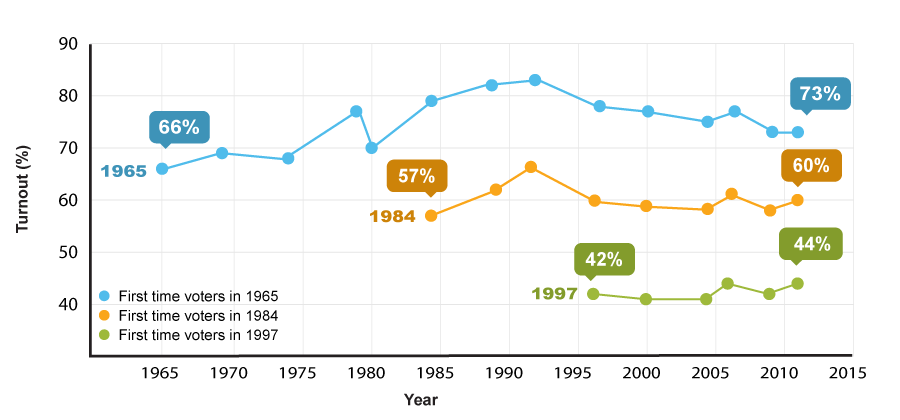
Voting is a learned habit. If a person votes in the first election after they turn 18, they will likely become a lifelong voter. Those who don’t are unlikely to pick up the habit later in life.
These findings come from a 2013 study that examined voter turnout for different cohorts between 1965 and 2011.
Text version of figure 4
| Election year | Voter turnout for first-time voters in 1965 | Voter turnout for first-time voters in 1984 | Voter turnout for first-time voters in 1997 |
|---|---|---|---|
| 1965 | 66% | ||
| 1968 | 69% | ||
| 1974 | 68% | ||
| 1979 | 77% | ||
| 1980 | 70% | ||
| 1984 | 79% | 57% | |
| 1988 | 82% | 62% | |
| 1993 | 83% | 67% | |
| 1997 | 78% | 60% | 42% |
| 2000 | 77% | 59% | 41% |
| 2004 | 75% | 58% | 41% |
| 2006 | 77% | 61% | 44% |
| 2008 | 73% | 58% | 42% |
| 2011 | 73% | 60% | 44% |
It showed that:
- Newer generations of youth were voting less than previous ones.
- Lower voting rates continued as those generations got older.
This shows how important it is to support young voters early, as long-term declines in youth participation can affect voter turnout for decades.
Why are fewer young people voting?
Elections Canada regularly carries out studies, including the National Electors Study for federal general elections, to see why many young people are not showing up to the polls.
Our research has found two broad categories of barriers to voting for young people: motivation and access.
Motivation barriers
Compared with older voters, youth:
- are less interested in Canadian politics
- have lower satisfaction with democracy
- believe that government and politics are too complicated to understand
- tend to see voting as a choice rather than a duty
Access barriers
Youth also:
- were less likely to receive a voter information card, indicating lower levels of registration
- were less aware that they could register at the polling place immediately before voting
- were less aware of the different ways to vote, such as at advance polls
- were more likely to expect that it would be difficult to vote, get to the polling place and prove their identity before they voted
- found the voting process less easy than older voters when they voted
How can we overcome these barriers?
Research suggests that, among young people, more knowledge about and interest in politics can help remove motivational barriers. Making the voting process simpler and more accessible is also key.
Strengthening civic education
Education plays an important role in preparing future voters. In the 2025 National Electors Study, young people were more likely to say that they voted if they:
- had learned about government and politics in high school
- had taken part in a mock election in primary or high school
Elections Canada’s Civic Education program supports educators by offering learning resources and student-friendly information on elections and democracy. The program aims to help future voters build the knowledge and confidence they need to participate in civic life.
Reducing access barriers
To make voting easier for youth, Elections Canada runs various programs, including:
Learn more
Families, schools, government and civil society will need to work toward making sure that future generations are engaged and prepared to vote. Elections Canada will continue to try and understand how barriers to voting are evolving and find effective ways to reduce them.
Helpful links
- Elections Canada’s Voter Turnout Dashboard
- Elections Canada's research on youth voting
- Research, analyses and data on the 45th general election
- Challenges related to the registration of young voters
- Preparing future voters during tax season
Last updated: May 2026
Footnotes
- 1
Official voter turnout: The number of votes cast divided by the number of registered electors.
- 2
Voter turnout by age: The number of votes cast divided by the estimated number of eligible voters. Using this adjusted method, national turnout in 2025 was 68% (as opposed to 69% official turnout).